
Mumbai: , India's consumer-goods bellwether, reported its strongest underlying sales growth in 14 quarters in the three months to September, but cautioned that elevated and below-normal monsoon rains could affect the pace of broader consumption recovery. HUL's turnover rose 15% to ₹18,071 crore in the September quarter, while underlying volume growth was 7%, despite price increases of about 7.5%. Net profit was flat at ₹2,796 crore, reflecting a one-off tax-related gain of ₹273 crore in the year-earlier period.
The Surf Excel-maker expects demand to remain resilient, though persistent inflation and pockets of rural stress remain key challenges for the industry in the coming months. 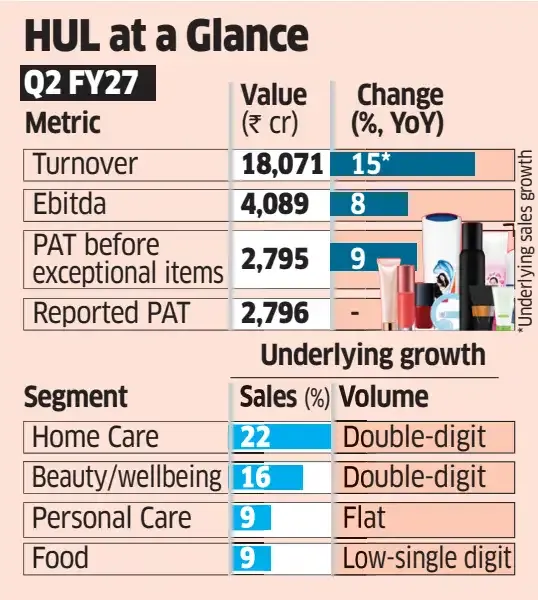
Also Read:
Segmental Breakdown
"Essentials have a low putdown price. So, at an overall level, these products tend to be less elastic to pricing as compared with other more discretionary categories. The fact that there is volume momentum while we are taking price increases is a very good sign for overall demand," said Priya Nair, managing director, HUL. "We have taken a significant price hike of 7.5% and yet we are seeing momentum sequentially on volumes."
India's largest consumer goods maker, considered a proxy for consumption demand in the country, said sales in both urban and rural markets remained positive, with rural demand increasing sequentially.
HUL also welcomed the package labelling requirements proposed by food safety watchdog FSSAI, saying they would enhance transparency, and that it would comply with all norms.
Unilever CEO Fernando Fernandez said India lapped a GST-led lower prior year comparator but saw significant share gains. "Our performance in India is boosted by significant share gains in our main categories, particularly in beauty laundry that are our two largest categories there. So, there is a bit of health from the market, but also our performance," Fernandez told analysts.
The broader rural outlook, however, remains patchy as rainfall deficits threaten agricultural output and incomes in some regions. Responding to concerns about the impact of the below-normal monsoon, Nair said, "The question is of wages, and really what happens to rural wages?"
Also Read:
She pointed to government support measures as potential cushions. "The MSP (minimum support price) has been taken up by 5% to 6% by the government, so that's a very good move. The other is we are seeing a higher (G-RAM-G) outlay, so there will be a cushioning of rural wages in the pockets that you know is a challenge," she said.
Encouraging Indicators
Nair cited India's 7.8% GDP growth in the June quarter and positive high-frequency indicators, including electricity demand, GST revenues and passenger vehicle sales, as signs of economic resilience. But she said "there are pockets of challenge" and that "inflation is the key challenge that you know everyone's looking at."
Earnings before interest, tax, depreciation and amortisation (EBITDA) rose 8% to Rs4,089 crore. Margin was 22.6%, down 140 basis points year on year.
"We will always cover costs. We will ensure that we do the right savings programs, the right efficiencies. But our focus is to deliver volume-led revenue and profit growth. So absolute profit growth is very important for us to also look at. That's really how our algorithm is structured," Nair added.
HUL chief finance officer Niranjan Gupta said it expects commodity inflation to remain elevated in the short term but the company is confident of keeping its medium-term within the guided range of 22% to 24%.
Homecare was the fastest-growing segment, with underlying sales growth of 22% and revenue of Rs6,878 crore. Double-digit growth across fabric wash and household care helped offset pressure from petrochemical-linked inputs. The segment's operating margin fell to 16% from 19% a year earlier. "To have taken a 10% price increase and still deliver 10% underlying volume growth in a category like home care actually depicts the strength of our brand and the resilience of our portfolio," Gupta added.
Beauty and wellbeing revenue grew 16% to Rs4,319 crore, supported by double-digit volume growth in hair care, skincare and colour cosmetics. Personal care revenue rose 9% to Rs2,617 crore, but volumes were flat. Skin cleansing delivered double-digit growth, supported by pricing and volume growth in Dove and Pears bars, while oral care recorded low-single-digit growth.
The food segmental revenue increased 9% to Rs3,849 crore, with low-single-digit volume growth. Tea remained under pressure, particularly at the mass-market end, as inflation weighed on performance.
Contact to : xlf550402@gmail.com
Copyright © boyuanhulian 2020 - 2023. All Right Reserved.